Bridging the Insight-Action Gap: Engineering a Multi-Model AI Governance & Predictive Traffic Framework
Disclaimer: While I take pride in my writing and design abilities, the infographics and part of the text for this case study are AI-generated. The entire theme of this case study is using AI to make content better, not worse; thus, it would be disingenuous of me to insist on creating every piece of this story. AI and humans, working together to scale efforts.
Strategy at a Glance:
- Traffic Optimization: Realized a 32% to 40% monthly traffic surge across optimized enterprise properties.
- User Satisfaction LFT: Projected a 50% lift in qualitative customer satisfaction via early-stage Qualtrics metric parsing.
- Predictive Precision: Established a highly reliable 0.60 monotonic relationship between AI rubrics and actual performance changes.
Engineering a Predictive Content Framework at the USPTO
How do you serve elite intellectual property attorneys and novice entrepreneurs on the same digital real estate? By blending multi-model AI workflows with time-series statistical modeling, I engineered a content governance framework that accurately forecasted user behavior, lifted qualitative satisfaction by 50%, and drove a 32%–40% monthly traffic surge.
Enterprise web properties often collapse under the weight of competing priorities. At the U.S. Patent and Trademark Office, our web ecosystem faced a persistent, systemic challenge:
How do you satisfy two completely divergent user profiles on the exact same digital real estate?
On one side sat enterprise-grade intellectual property lawyers requiring hyper-specific legal accuracy. On the other side sat pro se filers—small business owners and everyday entrepreneurs—who were entirely unversed in federal jargon. Traditional content management relies on human edits, which are difficult to scale and fail to systematically isolate where content leaves users behind.
To solve this, I spent two years designing and iterating a self-correcting, human-in-the-loop framework that treats content optimization as a measurable, data-scientific architecture. As a bonus, it uses classical statistical analysis as a sort of checksum and heat map; areas where the numbers don’t line up get flagged for human inspection.
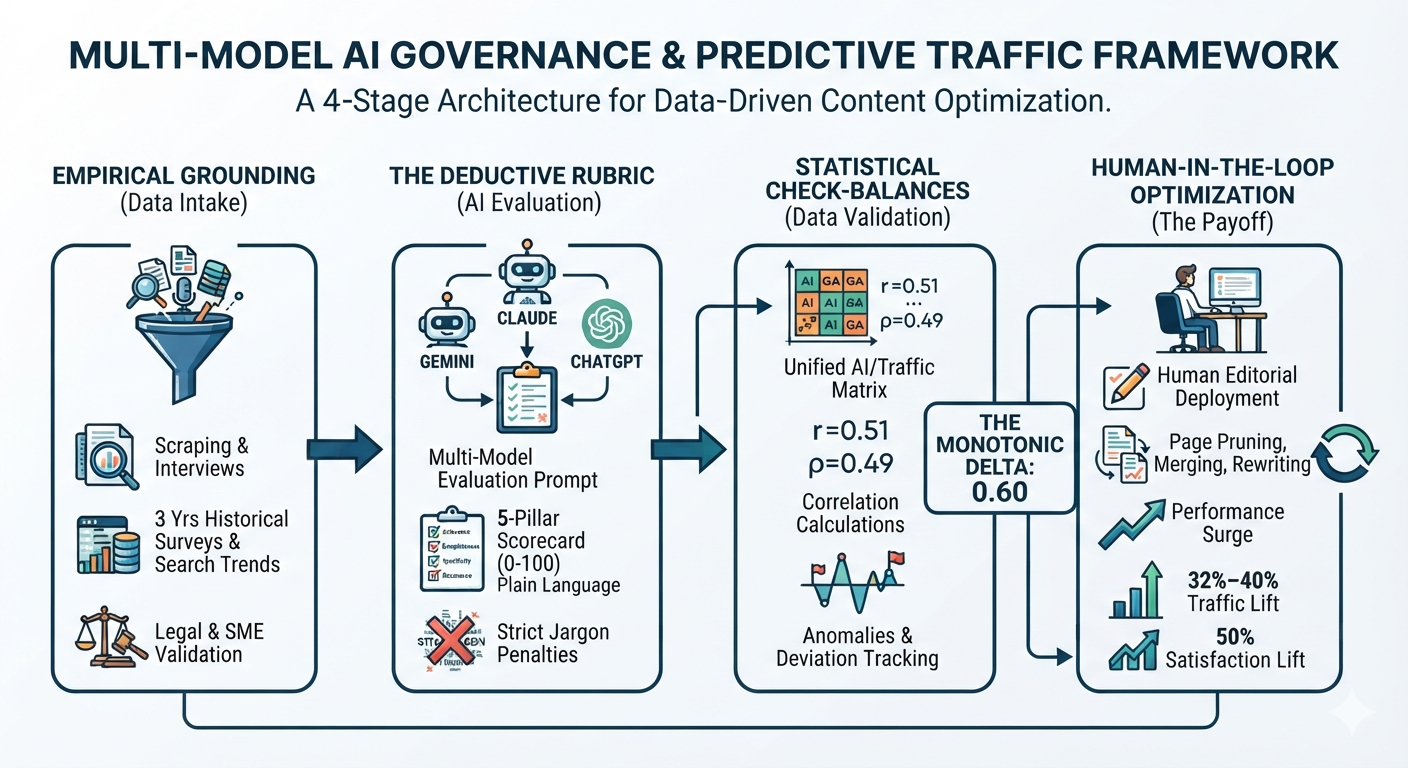
Infographic
The four-stage architecture of my multi-model AI governance & predictive traffic framework. Built by AI and validated by me, because that's the theme of this entire case study. I had to edit the output because some words and numbers didn't quite line up; and that's also the theme. You are responsible for your own outputs.
Benjamin Wilson
Methodology Phase 1: Designing the Validated Rubric & Multi-Model Scoring
Rather than relying on generic AI prompts, the foundation of the scoring engine required deep empirical grounding.Data Scrape & SME Validation: I extracted three years of customer service surveys, cross-referenced Google search trends, and conducted deep stakeholder interviews to isolate the core customer friction questions. These data points were then rigorously validated alongside legal subject matter experts (SMEs).The Plain-Language Deductive Rubric: I codified a strict rubric that dynamically grades content across five core axes: Semantic Relevance, Completeness, Specificity, Resonance, and Plain Language. To aggressively eliminate administrative friction, the engine enforces a strict rules-based penalty: deducting points for every unexplained acronym, initialism, or jargon term.Cross-Model Synthesis: To mitigate single-model drift, I engineered an evaluation loop utilizing Gemini, Claude, and ChatGPT to score web pages against the target question sets. By synthesizing outputs into an automated tracking ecosystem, the framework tracks mean scores while monitoring standard deviations to instantly surface outlier anomalies.
Methodology Phase 2: Statistical Modeling & The Traffic Bridge
A quality score is meaningless unless it correlates to real-world user behavior. To bridge the gap between quality metrics and platform performance, I unified our content scoring sheets with raw Google Analytics (GA) infrastructure.Using historical web trends, I engineered a time-series forecasting model—similar to a difference-in-differences approach—blending three years of historical GA data to smooth out macro seasonality spikes.To validate the system’s predictive accuracy, I ran Pearson’s correlation coefficient (r=0.51) and Spearman’s rank correlation (ρ=0.49) calculations against active monthly page views. Crucially, when evaluating the delta of improvement—the shift in score versus the shift in real-world performance—the correlation coefficient jumped to a highly robust 0.60. This proved that our rubric wasn’t just a backward-looking audit tool, but an accurate predictive engine for content ROI.
Human-in-the-loop implementation and scale

AI illustration
An AI illustration of a human and a computer getting along, generated by Firefly. Note the inaccurate number of fingers. Still, it gets the concept across.
Benjamin Wilson
The framework does not replace human talent; it hyper-focuses it. Armed with predictive correlation metrics, our editorial teams isolated historical pages that represented the highest priority trajectories. Curated content teams pruned duplicative text, established clean structural redirects for historical traffic footprints, and systematically re-drafted critical nodes to ensure clear, segmented user journeys based on filer intent. Upon re-grading post-edit content through the same multi-model architecture, we verified immediate, baseline performance improvements across our first pilot group—yielding localized monthly traffic gains between 32% and 40%.