Building the largest international dark sky sanctuary in the world took a lot of hands-on, interdisciplinary work. Making it popular took a lot of strategic communication.
Impact Metrics at a Glance:
- Economic ROI: +$8M in localized first-year tourism revenue.
- Audience Growth: +18% Year-over-Year cross-platform digital growth.
- Recognition: The steering committee received the Oregon Governor’s Tourism Award.
Summary
Building capacity, working with partners, understanding people, a strong theoretical basis, and equity: add it all up and it made a highly successful comms campaign resulting in 18% social growth and an estimated $8M in additional tourism revenue. Here’s an article I wrote about it.
Estimated read time: 4 minutes, 45 seconds
Background and constraints
One of my communication campaigns that had a big impact was the Oregon Outback International Dark Sky Sanctuary, which brought in national coverage, increased social audiences significantly, increased local tourism revenue by an estimate $8M in the first year, and brought the steering committee the Governor’s award. This case study focuses on intergovernmental relations, addressing equity issues, and building capacity.
South-Central Oregon doesn’t have a lot of people. When someone from Oregon talks to someone who is not from Oregon about Oregon, the image that typically comes up in conversation is the area around Portland and the Willamette valley, where about 70% of the state population lives. If you overlay a light pollution map onto the state, you get a really neat set of coincidences:
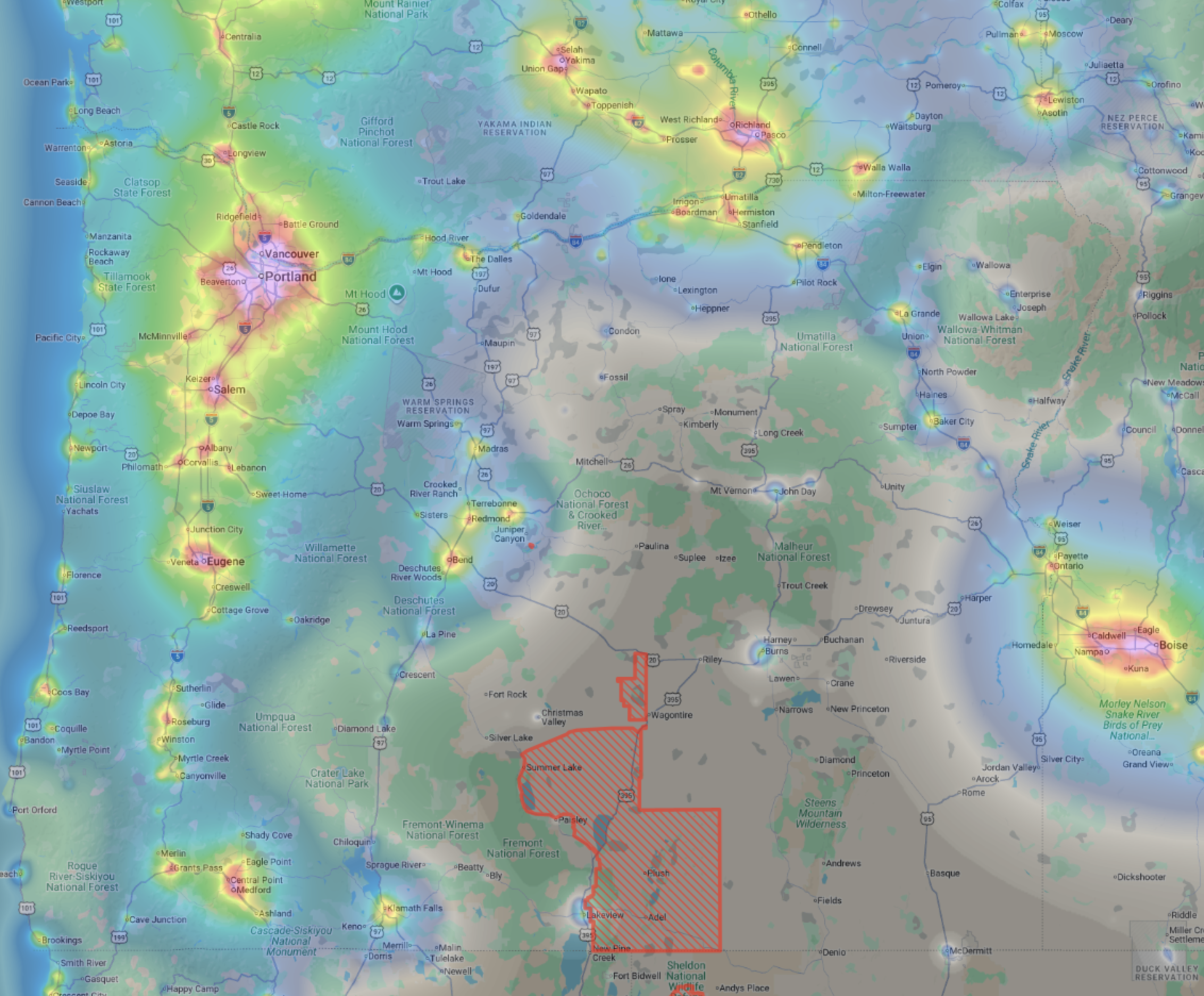
Map
Light pollution mapped over the State of Oregon. The red outlines indicate dark sky areas.
Benjamin Wilson
Lots of light pollution where all the people live, and not so much where population is sparse. Night skies are a natural resource, and there’s a causative relationship between population density and light pollution (humans use lights, which means increased light pollution), which makes preserving night sky quality challenging. It’s also an equal access issue: residents in urban centers don’t have ready access to high-quality night skies, and many people have other barriers, like language or transportation. Removing those barriers required planning and constant implementation, not an afterthought.
For the communities, developing a dark sky sanctuary meant signing agreements where the county and city governments won’t develop in certain areas, or if they have upward-pointing electric lights they might need to replace them with more efficient lights, downward-pointing lights, or add timers and sensors to lessen the impact on the night skies. There were additional considerations as well, mostly not relevant to this case study.
Governance, friction, and boundary management:
Preserving a pristine natural nightscape requires strict multi-jurisdictional policy alignment, which cannot help but introduce local friction. During the planning phase, one county expressed concerns regarding the economic ROI of retrofitting municipal lighting infrastructure and opted out.
Rather than stalling the initiative, we dynamically adjusted the geographic scope of the sanctuary, utilized social listening to address community concerns, and moved forward with an optimized boundary framework. This adaptive governance protected the project’s strict launch timeline while maintaining absolute cross-agency alignment with the Bureau of Land Management, the U.S. Forest Service, and remaining municipal partners.
Communications methodology:
The elevator pitch for how the whole thing worked is; I identified a number of people groups all up and down the West Coast, found ways to talk to them, identified barriers to access, set up events so that people could come enjoy the skies, and then everyone took pretty pictures of stars. This drives the economy and gives people a reason to care about conservation.
The longer version: In order to achieve the right amount of message saturation in local and less-local publics, we built our communications plan using my data-driven interaction and diffusion model of communication (based on the Osgood-Schramm model).
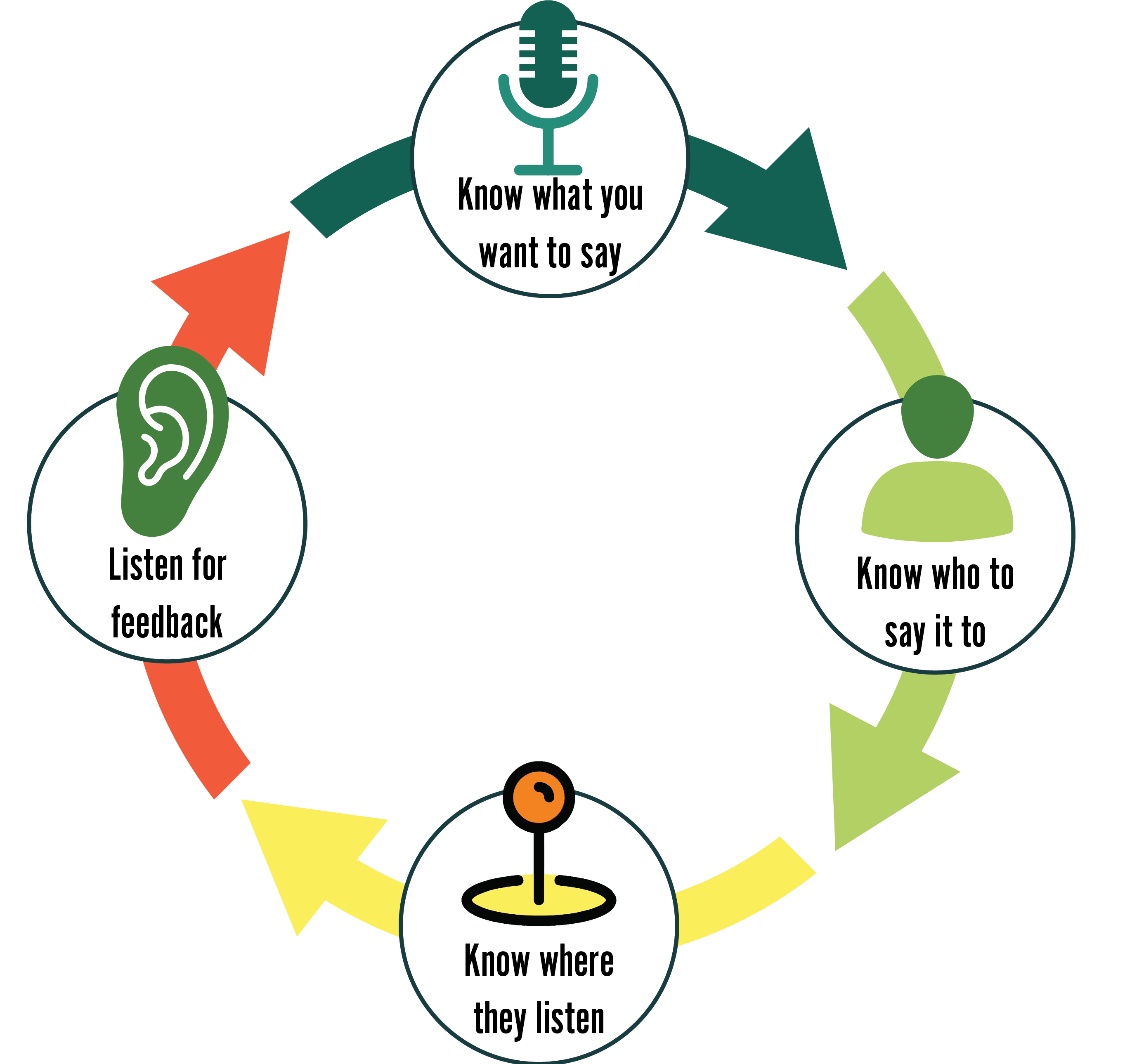
Infographic
Data-driven Interaction and Diffusion model based on the Osgood-Schramm model
Benjamin Wilson
It goes like the above infographic;
- Know what you want to say
- Know who you want to say it to
- Know where they’re listening
- Listen for feedback
And then you iterate. As models go, it’s excellent and has the benefits of simplicity and relatability, but as Korzybski said,
The map is not the territory. Alfred Korzybski
Equity-Centered Architecture & Omni-Channel Diffusion
True accessibility means mapping communications to actual user infrastructure, not assumed access. Because the target audience spanned urban centers down the West Coast to remote rural pockets in South-Central Oregon, I structured a stratified audience matrix:
- The Digital Divide: For regions like Adel and Langell Valley with minimal broadband penetration, we deployed localized print media buys and hyper-targeted AM/FM radio spots. This infrastructure mapping also pulling double-duty as a framework for emergency wildfire communications later on.
- Physical Access Barriers: Recognizing that light pollution disproportionately affects urban centers where residents may lack transportation to remote public lands, we partnered with transit and community groups to coordinate shuttle operations, physically bridging the gap between underserved communities and the sanctuary.
- Multilingual Deployment: To ensure inclusion for non-English speaking regional demographics, all critical campaign collateral and digital storytelling assets were translated and audited during the primary creation cycle—never as an afterthought.
Operational readiness and capacity engineering
A high-impact communication strategy is only as effective as the infrastructure built to execute it. Prior to launch, I engineered a comprehensive operational readiness program designed to upskill our multimedia team, maximize resource utility, and establish deep internal ownership.
- Strategic Talent Acquisition & Inclusion: Reconfigured the hiring matrix to evaluate candidates based on diverse qualitative skill sets and community-representative backgrounds, successfully moving away from tokenized compliance toward a high-performance, inclusive creative unit.
- Advanced Technical & Media Upskilling: Implemented an intensive cross-training pipeline focusing on low-light astrophotography, short-form video production, and high-stakes media simulation. This proactive training gave the team hands-on interview experience and technical mastery before facing national press.
- Cross-Functional Risk Mitigation: Spearheaded an initiative to get our creative staff Red-Card certified to work near active wildfire lines. This unconventional qualification established immediate operational credibility with incident management teams, breaking down traditional bureaucratic silos and securing unmatched, front-line media access that paid massive dividends during subsequent regional crises.
- Capital Resource Optimization: Procured, assigned, and managed individualized mobile journalism and digital media kits for each team member, eliminating technical bottlenecks and empowering the team to deploy rapidly across remote geographic zones.
- Iterative Proof of Concept: Established an internal sandboxed testing cycle within the sanctuary boundaries prior to the public unveiling. By allowing creators to pitch, produce, and publish preliminary content with direct bylines, we built early brand ownership and established a reliable baseline of high-quality assets to anchor the primary media launch.
Some of our partners also produced maps of the OOIDSS, which we distributed. This involved a series of consultations with different groups: the Klamath Tribes, archeologists, partners. Of intellectual interest to me was the richness of archeological sites in the region, which had to be protected and excluded from maps. Tribal representation and consultation with archeologists was key to ensuring that everyone’s values were respected equally.
How did all that shake out?
We made a major impact, to be honest – and it’s a system that’s still going. An 18% increase in social growth, and that estimated increase to tourism is extending far beyond the borders of the Dark Sky Sanctuary. Visit Bend, the tourism marketing organization for Bend, Oregon, a mountain town that depends on tourism, but exists hours away from the edges of the sanctuary, regularly features messaging about being a dark sky destination – and they should. It benefits the town, benefits the visitors, and benefits society; a win for everyone.